
The Institutions That Save Us
What Robert F. Kennedy Jr. has dismantled, and what it is already costing

Two outbreaks are burning simultaneously as I write this.
In the Ituri Province of the Democratic Republic of Congo (DRC), the Ebola Bundibugyo virus — a strain for which there is no licensed vaccine and no targeted treatment — has spread to at least nine health zones. Cases crossed the border into Uganda within days, with confirmed deaths in Kampala. As of this writing, the WHO has declared a Public Health Emergency of International Concern. Suspected cases rose from 246 to 500 in 96 hours. Health experts were alarmed not just by the pace of spread but by how late the world found out: the outbreak had been circulating for weeks before it was publicly confirmed.
In the Atlantic Ocean, passengers and crew aboard the MV Hondius, a Dutch expedition cruise ship, began falling ill with Andes virus, a strain of hantavirus that is — uniquely among hantaviruses — capable of person-to-person transmission. Three people have died. Ten cases are confirmed thus far. The Centers For Disease Control (CDC) issued health advisories and activated its Emergency Operations Center. The agency coordinated with international partners, issued guidance to affected Americans through the State Department, and monitored contacts at ports across the United States.
I am a retired Navy Senior Chief Petty Officer whose career was in preventive medicine, and a retired DoD Senior Intelligence Officer whose work included tracking foreign medical capabilities and infectious disease threats. I have spent my professional life thinking about exactly these scenarios: novel pathogens, international surveillance networks, the infrastructure that catches outbreaks before they become catastrophes. What I am watching right now fills me with a cold, specific dread — not because either of these outbreaks will necessarily become the next pandemic, they likely won’t — but because the institutions that would contain them if they did, have been systematically dismantled or sabotaged over the past sixteen months.
This is the story of how that happened, and who is responsible.
What “Working” Looks Like
To understand what’s been lost, you have to know what it looked like when it worked.
In the spring of 2014, Ebola broke out in Guinea. Within months it had spread to Sierra Leone and Liberia, overwhelming health systems that had no capacity to contain it. By September, the World Health Organization's (WHO's) own internal report acknowledged that the agency had missed chances to prevent the spread, blaming incompetent staff, insufficient information, and a failure to grasp that traditional containment methods wouldn't work in a region with porous borders and broken health infrastructure.
The United States stepped in. President Obama deployed CDC's Emergency Operations Center to Level 1 — its highest activation. More than 500 CDC staff worked the outbreak. USAID organized a Disaster Assistance Response Team. The military established a command in Liberia. Congress appropriated $5.4 billion in emergency funding — the largest-ever U.S. government response to a global health crisis. CDC worked hand-in-glove with WHO, with African ministries of health, with partner nations, and with the international network of disease detectives and laboratory scientists whose entire purpose is to chase outbreaks across borders before those outbreaks chase us.
By the end of 2015, the outbreak was over. More than 11,000 people had died — a tragedy by any measure — but the international response had prevented what could have been much worse. The tools that accomplished this were not improvised. They were institutional: built and staffed over decades, by professionals with deep specialized expertise, sustained by consistent funding, and connected by relationships of trust and communication with counterparts around the world.
None of that is by accident. It’s the accumulated investment of decades, of generations of public health professionals who understand that infectious diseases do not respect borders, that surveillance and response capacity built during quiet times is the only thing that works when the crises arrive, and that the United States — the world's most capable public health actor — has had the obligation and the self-interest to lead.
That infrastructure is now in ruins.
How We Got Here
Robert F. Kennedy Jr. did not invent anti-vaccine myth (or fixation). But, more than any other single individual in the first quarter of this century, he transformed it from fringe anxiety into a mainstream political force — and he did it by fabricating evidence. By lying.
In 2005, Kennedy published an article published simultaneously by Rolling Stone and Salon, alleging that the CDC, the Food and Drug Administration (FDA), and vaccine manufacturers colluded to conceal a study linking thimerosal — a mercury-based preservative used in some vaccines — to autism in children. The article was, to put it plainly, a lie. Thimerosal had already been removed from nearly all routine childhood vaccines four years before Kennedy wrote about it. Subsequent research has found no link between thimerosal and autism. Salon retracted Kennedy's article in 2011 and Rolling Stone removed it shortly after. But, the damage was done. Millions of parents read it, shared it, and made vaccination decisions for their children based on it.
That’s where Kennedy earned his anti-vaccine credentials — not through science, but through a fabricated and retracted article about a preservative that was already taken out of vaccines before he claimed it was harming children.
Attacking public health as a political weapon came in due time. During the 2014 Ebola outbreak — while CDC and its international partners were in the process of containing effectively — Republican politicians and right-wing media made a calculated decision to treat the crisis as a political opportunity rather than a public health emergency. Donald Trump, alone, tweeted roughly fifty times in October 2014 that the outbreak demonstrated Obama's failures, calling it "Obama's fault," demanding flight bans, and raging about troop deployments to Africa. Ted Cruz was “concerned” that the federal government didn’t taking the crisis "seriously." Fox News contributors suggested Obama perhaps wanted America to suffer from Ebola because of his "affiliations" with Africa. When an American physician and nurse from Samaritan’s Purse — Franklin Graham’s NGO — were enroute to Emory University Hospital in Atlanta, Georgia for treatment for Ebola, contracted as the tried to save lives in difficult and dangerous conditions, Donald Trump, then an aspiring Presidential candidate, tweeted “The U.S. cannot allow EBOLA infected people back. People that go to far away places to help out are great-but must suffer the consequences!”
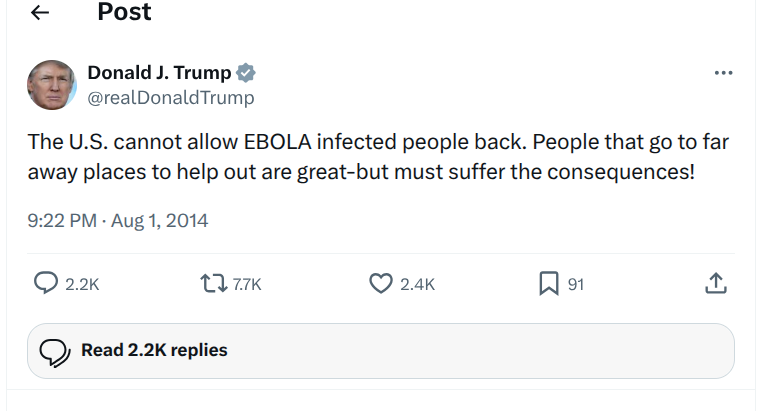
The record is pretty clear on what was happening: Republicans saw the 2014 midterms approaching and calculated that blaming President Obama for an outbreak he was actively working to contain was politically advantageous. They connected Ebola to immigration, to border security, to the broader narrative that Obama’s administration couldn't be trusted to protect Americans. The fact that Ebola was successfully contained — that the institutions held and that the response worked — barely produced an acknowledgment much less an apology to the hundreds of people — including President Obama — that made it happen.
The pattern repeated with Zika in 2016, and then, catastrophically, with COVID-19 in 2020. By the time the the COVID-19 pandemic arrived, nearly a decade of deliberate institutional delegitimization had done its work. A substantial portion of the American public had been taught, by political leaders they trusted, that CDC was not to be trusted, that public health recommendations were politically motivated, that scientists who said inconvenient things were part of a conspiracy against ordinary Americans and, of course, Donald Trump. In that poisonous atmosphere, Dr Anthony Fauci at the National Institutes of Health (NIH) and scientists and physicians at CDC made their recommendations — and were savaged for it. Dr Fauci still needs bodyguards three years and six months after retiring from 38 years of service protecting Americans’ health.
The savaging was not spontaneous. It was the harvest of seeds planted in 2014, watered in 2016, and brought to full toxic flower by a political movement that had decided that public health expertise was an enemy to be destroyed rather than a resource to be used. Robert F. Kennedy, Jr was always part of that movement, even before he was officially in it. His Children's Health Defense organization spent years amplifying vaccine misinformation, exploiting tragedy — as when two Samoan babies died from improperly prepared MMR vaccines; the resulting fear drove vavvination rates, already low across the island, catastrophically downward — and building a constituency of Americans primed to distrust any public health institution that told them something they didn't want to hear.
Then Donald Trump appointed him Secretary of Health and Human Services.
The Vandal
What Kennedy has done at HHS in sixteen months is not reform. It’s demolition.
More than 7,000 workers at the CDC, NIH, FDA, and Centers for Medicare and Medicaid Services received layoff notices in a single morning in April 2025 — staffers with decades of specialized expertise receiving emails at 5 a.m. telling them they were on administrative leave effective immediately. The CDC alone lost 2,400 positions in that wave, on top of the more than 1,000 scientists, doctors, and public health officials fired in a subsequent "Friday night massacre" in September 2025. The entire director's office of the National Center for Immunization and Respiratory Diseases was wiped out. The office of the director of the CDC's Global Health Center — the office tasked with tracking and responding to health threats globally — was abolished.
The CDC's cruise ship inspection program, the Vessel Sanitation Program, lost all its full-time inspectors. The agency's communications programs were ended. As former CDC Director Tom Frieden noted, when you cut CDC's budget, you are not just cutting Washington staff — approximately two-thirds of CDC funding flows out to state and local health departments and community organizations. Gutting CDC guts public health capacity in every state in the country.
Kennedy fired all seventeen members of the CDC's Advisory Committee on Immunization Practices — the body that shapes the nation's vaccine schedule and has guided vaccination policy for decades — and replaced them with a smaller panel that included several people with documented anti-vaccine views. He hired Lyn Redwood, a longtime anti-vaccine ally who had served as president of his Children's Health Defense organization, to deliver presentations to the new panel citing a study that, when researchers looked for it, did not exist. The false citation quietly disappeared. Redwood was subsequently hired into a vaccine safety role at the CDC itself.
Kennedy reopened the long-debunked vaccines-and-autism debate. He undermined his own epidemiologists during Texas’s measles response — while the country was experiencing its largest measles outbreak in three decades, with children dying. He rescinded the federal recommendation for flu vaccines containing thimerosal — a preservative that, as noted, was removed from childhood vaccines 25 years ago, before Kennedy's own 2005 article, and that studies demonstrated was not linked to any harm.
On January 26, 2025, the administration issued a gag order prohibiting all CDC communication with WHO. Modified but never rescinded, and effectively made permanent by the U.S. withdrawal from WHO, the order meant that the premier public health agency in the world could not talk to its international counterparts.
As epidemiologist Jennifer Nuzzo of Brown University's Pandemic Center put it, with the clarity of someone watching a car crash in slow motion: "When there was the suspected outbreak of Ebola in the DRC a few weeks ago, CDC couldn't call them and ask what's going on."
The Cost, Right Now
The current Ebola outbreak in Ituri Province is the DRC picking up the bill for our country’s public health “dine and dash.”
The outbreak was caused by the Bundibugyo strain — one of the rarest Ebola variants, last seen in an outbreak in 2012. Initial samples tested negative because the tests used detected only the Zaire strain. By the time Bundibugyo-specific tests confirmed the diagnosis, hundreds of people were already sick. Health experts expressed alarm not just at the scale of the outbreak but at how long it had gone undetected — circulating invisibly for weeks through a high-traffic gold mining region before anyone knew it was there.
Epidemiologist Jennifer Nuzzo said the delay in detection could be a direct result of cuts to global health programs. She was not speculating. The International Rescue Committee reported that major funding cuts beginning in March 2025 had forced it to reduce programming in Ituri Province from five areas to two — and those two areas are precisely the epicenter of the current outbreak. U.S. funding to the DRC through HHS fell from nearly $33 million in fiscal 2024 to less than $10 million in 2025. USAID, which had sent nearly $715 million to the DRC in fiscal 2025 and nearly $1.2 billion the year before, was effectively dismantled by Trump administration’s State Department. In the conflict areas where Ebola rages, humanitarian aid workers serve as an informal surveillance network — reaching places government workers cannot, hearing about strange clusters of illness, and flagging them to officials. That network, once funded largely by the United States, is mostly gone.
"We are just in a much, much weaker position now to respond to a challenging Ebola outbreak like this one than we would have been even 18 to 24 months ago.”
—Jeremy Konyndyk, a former senior USAID official, speaking to NPR.
Meanwhile, at the WHO — the international body that coordinates the global response to exactly these crises, that declared the current Ebola outbreak a Public Health Emergency of International Concern — roughly 2,371 staff members are being shed by mid-2026, approximately a quarter of the workforce, with the African Regional Office particularly affected. The institution that contained the 2014 outbreak is operating at three-quarters strength, in the region where the outbreak is burning, after the United States — its largest single funder — walked away.
The CDC, to its credit, has activated its Emergency Operations Center for the current outbreak and has over 30 staff members in the DRC country office, with more deploying. The agency is doing what it can, with what remains. But the CDC's incident manager acknowledged to reporters that they were only notified of the first confirmed case the day before the outbreak was publicly announced — far later than the early warning the international surveillance network would normally have provided. The informal early warning system, built on USAID presence and CDC relationships with local health ministries, no longer functions the way it did.
This is what gutting health institutions looks like. Not immediate, not dramatic, it looks like a warning that arrives a day late instead of a week early. It looks like an IRC team covering two health zones instead of five. It looks like a WHO regional office working with 25% of its staff missing. It looks like an outbreak that reaches hundreds of cases before the world even knows it exists. And then, if luck runs out, it looks like something much worse.
What Has Been Thrown Away
I spent a career in Navy preventive medicine and then in tracking foreign medical capabilities and infectious disease threats for the Defense Intelligence community. I understand, at a level that is not theoretical, what these institutions do and why they matter. I have watched the international surveillance network function. I know what it costs to build the relationships — between CDC and WHO, between USAID field officers and local health ministries, between American disease detectives and their counterparts in countries where the next outbreak will begin — and I know that those relationships, once severed, are not quickly rebuilt. Trust in public health, like trust in institutions generally, that takes decades to build, can be destroyed in weeks.
Robert F. Kennedy Jr. built his career on a retracted article. He spent twenty years amplifying fear and eroding the institutional trust that makes vaccination programs work. He was rewarded with cabinet-level authority over the very institutions he spent his career attacking. And he has used that authority with the thoroughness of someone who always intended to burn the house down.
The 2014 Ebola outbreak was contained because the institutions held. CDC had its relationships with DRC and with WHO. USAID had its people in the field. The international surveillance network caught the outbreak, tracked it, and supported the response that ended it. Those tools were available because previous generations of public health professionals and political leaders understood that you build the fire station before the fire starts.
The fire station is being dismantled. The fire has started. And the man holding the sledgehammer is calling it health freedom.