
Remembering Pearl Harbor
Bloch Arena and the night before, with some additional thoughts

I wrote this three years ago on the 81st anniversary of the Pearl Harbor attack. Today is the 84th anniversary. I follow the original post with some additional thoughts below.
Today is the 81st anniversary of the attack on Pearl Harbor. During my three year assignment at Pearl Harbor ('83-'86) my family and I took in many of the sites associated with that attack. We saw the USS Arizona Memorial and the USS Utah, which was sunk on the opposite side of Ford Island from Battleship Row. You could still see the damage done to the flight tower on Ford Island, which has been preserved as a historical site. There are similar damages to be seen still, I'm sure, at Hickam, Wheeler and Kaneohe air bases.
The most poignant site for me was Bloch Arena, where sailors were enjoying a "Battle of the Bands" between bands from USS Arizona and USS Pennsylvania the night of December 6th.
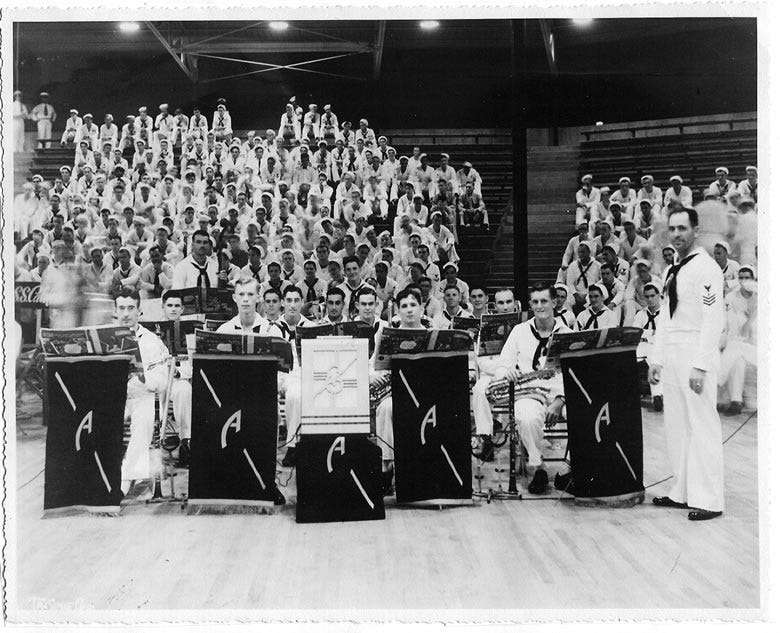
(Photo courtesy of the USS Arizona Memorial Association)
Bloch Arena was brand spanking new on December 6th, 1941. The sailors enjoying themselves that night probably knew things were tense with the Empire of Japan. After all, most of them were recent arrivals, the Pacific fleet having been beefed up because of rising tensions with Japan. And the sailors knew what was happening in Europe, and on the Russian and Ukrainian steppes, and of the horrors visited in China by Japanese forces. But December 6th was a night of fun and relaxation. The ships’ bands had been competing for a couple of months and were down to the semi-finals. Elsewhere in Honolulu, officers were partying at the Moana and Royal Hawaiian hotels and many of the sailors’ shipmates were taking in the pleasures of Hotel Street and Waikiki beach, joined by soldiers from Army and Army Air Corps bases on Oahu.
They had no idea what the morning would bring.
In the mid-80s, Bloch arena looked very much as it did 40 some years before. And you could feel the ghosts of those young sailors still present, as they were before their—and our—world changed forever.
If you are interested in Bloch Arena and Navy Life in pre-war Pearl Harbor this link will take you to Scotty Moore’s history of Bloch Arena. It’s worth the reading.
Additional Thoughts
In a seminal study of the Pearl Harbor attack, Pearl Harbor: Warning and Decision, Rebecca Wohlstetter argued that the U.S. Government and Army and Navy did not lack information leading up to the attack. Rather, crucial signals were lost in a “blizzard of conflicting or erroneous information,” or noise.
Wohlstetter’s thesis; surprise attacks occur when decision-makers misinterpret signals as noise and vice versa, often referred to as “the Roberta Wohlstetter problem,” is perhaps the classic case of intelligence failure analysis. Her 1962 book was cited by the 9/11 Commission in drawing parallels to the intelligence failures preceding the September 11, 2001 attacks. It was often cited by Donald Rumsfeld when he was Secretary of Defense under President George W, Bush.
I give great credit to Ms Wohlstetter’s analysis, and I think there were other factors at play as well as Pearl Harbor approached. Outside of the State Department, the United States had no real strategic intelligence capability. And what capability existed in the State Department was distracted by the war in Europe, and heavily focused on implementing Lend-Lease aid to Britain and their new ally, the USSR.
There was also a general belief in Washington DC and throughout the United States that Japan could not, or would not, attack the Hawaiian Islands. Planning and executing such a an attack was thought too big a lift for a woefully underestimated Japan. The more likely target for Japanese forces—should they attack—would be The Philippines. That it would be either/or, one target or another, displays a failure of imagination (and prejudice) that isn’t limited to 1941 or the United States. Simply, American planners didn’t consider that Japan a might attack Pearl Harbor and the Philippines, and much, much more (see Chronology of Japanese Attacks below).
In 1941 the United States had a nascent but effective technical intelligence collection capability. Our ability to analyze what we collected was hampered by our inability to discriminate signals from noise, as noted by Ms Wohlstetter, and by a constricted, some might say constipated world view and conviction that what one wanted to be mattered as much or more as evidence to the contrary.
In the years since 1941, the United States has built an incomparable technical and human collection capability. We built analytic capability in our diplomatic, military, and intelligence communities that was unrivalled in the world. Although the US has had its share of “intelligence failures” in the intervening years, they were, as often, failures of policy makers to pay attention to intelligence analysts.
The question we should ask on this 84th anniversary of Pearl Harbor is whether changes in our intelligence and security communities—brought about this year—will set us back and leave us again vulnerable to world-changing consequences.
And if you have time, think again about those young sailors enjoying a night of liberty, music, and dancing with their girl-friends on the last night of the world they had known.
Chronology of Japanese Attacks After Pearl Harbor
Pearl Harbor, Hawaii: Attack began at 7:55 AM local time
Japanese forces struck simultaneously across the Pacific as part of a massive coordinated offensive
December 8, 1941 (Monday) Due to the International Date Line, it was already December 8 in Asia when Pearl Harbor was attacked:
Malaya: Japanese forces landed at Kota Bharu on the northeastern coast shortly after midnight.
Thailand: The Japanese 5th Division landed at Pattani and Songkhla in southern Thailand
Hong Kong: At 04:45 Hong Kong time, the Japanese attack began. At 06:00, three Japanese regiments crossed the Sham Chun River
Philippines: The duty officer at U.S. Asiatic Fleet headquarters in Manila received word of Pearl Harbor at 02:30. Nine hours later, Japanese pilots attacked Clark Field, destroying most American heavy bombers
Guam: Japanese aircraft from Saipan struck the island, sinking the minesweeper USS Penguin
Wake Island: Japanese air raids commenced, destroying most of VMF-211’s aircraft on the ground
Singapore: At 04:00, 17 Japanese bombers attacked Singapore in the first air raid on the colony
December 9, 1941 (Tuesday)
Hong Kong: Japanese troops mounted a massed attack on the western portion of the Gin Drinkers’ Line defensive position
Guam: Japanese planes returned to continue devastating attacks across the island
December 10, 1941 (Wednesday)
Hong Kong: The Gin Drinkers’ Line collapsed
Guam: The Japanese put ashore approximately 400 men at Dungcas Beach early in the morning. After token resistance, the garrison surrendered at 05:45
Malaya: The British battleship HMS Prince of Wales and battlecruiser HMS Repulse were sunk by Japanese aircraft—the first time capital ships at sea had been sunk by aircraft
Philippines: Japanese air raid on Cavite Navy Yard
December 11, 1941 (Thursday)
Hong Kong: As Japanese troops advanced southward along the Kowloon Peninsula, British commander Maltby ordered evacuation of all troops to Hong Kong Island
Wake Island: A Japanese landing attempt was repulsed with heavy losses
December 13, 1941 (Friday)
Hong Kong: The Rajputs of the British Indian Army, the last British troops on the mainland, fell back onto Hong Kong Island
December 18, 1941 (Thursday)
Hong Kong: Japanese troops made the short crossing from the mainland to Hong Kong Island
December 19, 1941 (Friday)
Hong Kong: Japanese troops surrounded a Canadian-held command post at Wong Nei Chong Gap, where Brigadier John K. Lawson was killed
December 23, 1941 (Tuesday)
Wake Island: A second Japanese amphibious assault was successful. The outnumbered U.S. defenders surrendered later that day
December 25, 1941 (Thursday - “Black Christmas”)
Hong Kong: At 15:30, Governor Young and General Maltby surrendered to General Sakai at the Japanese headquarters at the Peninsula Hotel after 17 days of fighting
Into January 1942
The Japanese offensive continued with further advances in the Philippines, Malaya, and the Dutch East Indies, ultimately leading to the fall of Singapore on February 15, 1942.
This coordinated offensive demonstrated Japan’s strategy to rapidly seize resource-rich territories across Southeast Asia and the Pacific while attempting to neutralize American military power in the region.
(Chronology is courtesy of Claude, by Anthropic)
Excellent review, Denis! You mentioned bias, and I want to amplify that point. It's hard for us today to realize the extent racism played in our surprise. Views of the Japanese as an "inferior" face were as prevalent in America as were the "superior race" mentality of Japanese militarists.
Although the Japanese had humbled the Russians in 1905 and seized Germany's Pacific holdings during WWI, many in the States still viewed them as incapable of fighting America. Even their victories in China were passed off as some sort of intramural affair. Lurking behind many of our failures leading up to the war was the assumption Japan just wasn't up to our standards.